





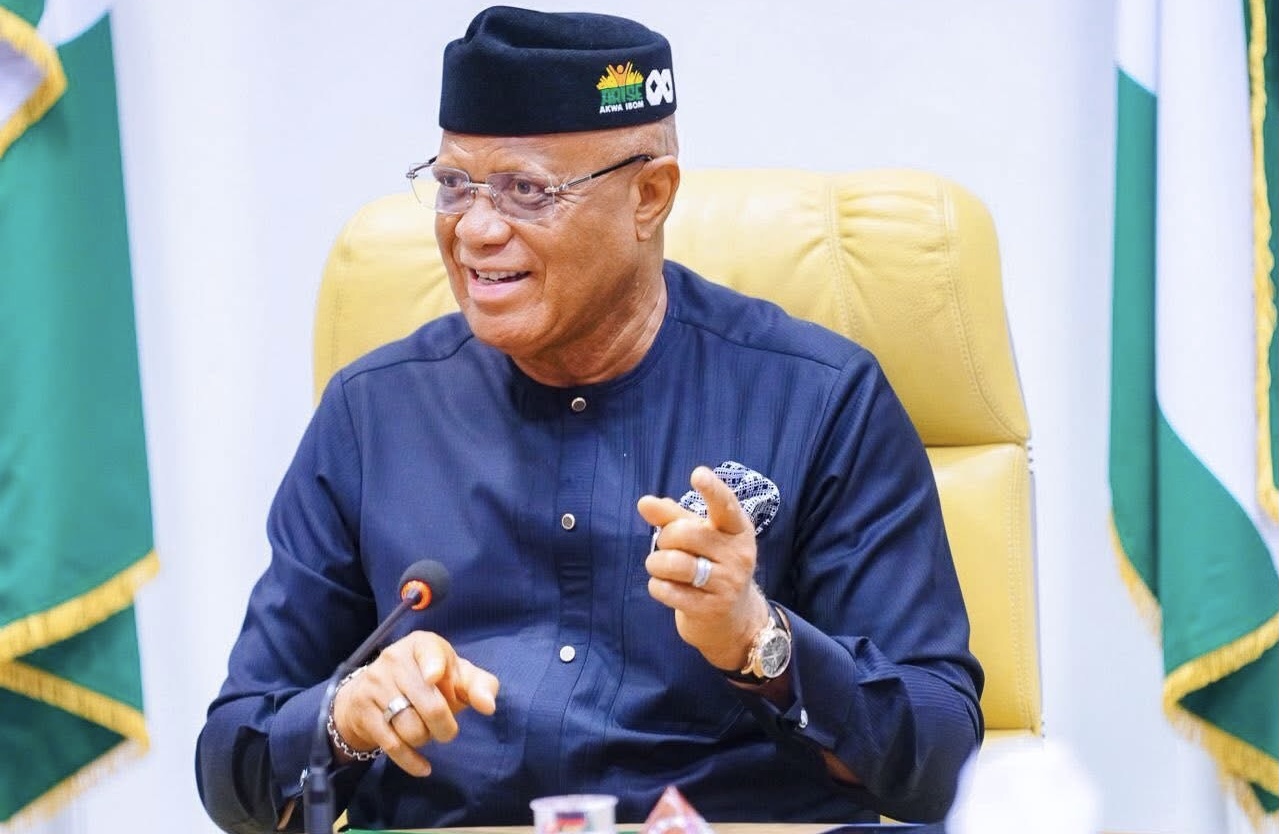
By Aniekan Umanah
Uyo.
Is it not remarkable that, with party primaries scheduled just hours away, Akwa Ibom State remains so calm, peaceful, tranquil and united?
The ruling party, the All Progressives Congress (APC), begins its primaries on Saturday, 16th May 2026, yet there is no visible build-up of tension, no restless drumbeat of discord in the air. What we see instead is a stillness that speaks, a quiet that reassures. This is the harvest of leadership, intentional, deliberate, and firmly rooted in the cultivation of sustainable peace.
Governor Umo Eno working closely with Senate President, Godswill Akpabio and other Party Leaders clearly had drawn a firm line through the old seasons of political turbulence, those years of mistrust, exaggerated rivalries, and needless expenditures born of primaries that too often resembled battlegrounds rather than democratic exercises. Today, the familiar camps are no longer pitched against one another like rival armies awaiting signal for conflict. The fever has broken; the air feels different.
The clarity of this moment became even more visible when the Governor, alongside the Senate President, convened a stakeholders’ meeting in Uyo, followed by similar engagements across all 31 local government areas. The outcome was consistent: a chorus of peace, unity, and progress now defining the political atmosphere under Governor Eno’s watch—without desperation, without violence, only cautious optimism.
Even the Governor himself attended his local government stakeholders’ meeting quietly after official hours, reflecting his philosophy that governance does not pause for politics. The ARISE Agenda continues to move steadily, driving transformation across sectors and reshaping the State’s development trajectory even in a politically charged season.
At every point, he continues to balance governance with politics so that no vacuum is created. On Thursday, May 14th, after a full day of official duties and an extended Tourism Committee meeting that ran into the night, the Governor proceeded on an unscheduled visit to the audacious ARISE Palm Resort for a night inspection of what is envisioned as the “Disneyland of Africa,” amplifying his hands-on leadership.
The ARISE Agenda itself represents a sweeping transformation of Akwa Ibom State across key sectors. It includes over 1,300 kilometres of roads and 40 bridges, strengthening connectivity across communities and boosting commerce and integration.
It further extends into tourism and hospitality with landmark assets such as the ARISE Palm Resort, the International Convention Centre with a 5,000-capacity hall, Ibom Hotels, and the ARISE Shopping City, positioning the State as a rising destination hub.
In agriculture and industrialisation, the Ibom Model Farms are redefining food production systems and value chains, while in healthcare, the 350-bed International Hospital, model schools, and model healthcare centres are expanding access to quality services.
The transformation also covers security architecture, ensuring stability and safety for residents and investors alike, alongside the Oron Maritime Infrastructure, which strengthens coastal and transport development.
A forward-looking clean energy transportation is also underway through the CNG initiative, while human capital development and citizens’ empowerment programmes continue to expand opportunities and inclusion across the State.
But it was not always so. Since Nigeria’s return to democracy in 1999, political life has often mirrored a storm of rivalry, tension, and uncertainty, sometimes leading to calls—out of frustration—for the orderliness of military rule.
Akwa Ibom was not spared this turbulence. From Arc. (Obong) Victor Attah to successive administrations, political transitions were often marked by fierce contestations and intra-party struggles that shaped the State’s democratic journey.
In 2003, Obong Attah faced stiff opposition from the late Dr. Ime Umanah of the APP, with tensions running high across the State, while the “Abuja Front” and “Home Front” divide further strained cooperation and slowed development.
By 2007, under Obong Godswill Akpabio, PDP primaries were highly contested, stretching over several days with more than fifty six aspirants vying for the ticket, reflecting the intensity of internal party battles.
In 2011, Akpabio’s re-election bid triggered severe political tension , with destruction of property,, and tensions instigated by some contenders.
The 2015 election cycle witnessed the emergence of the G-22, a group of aggrieved aspirants who opposed Mr. Udom Emmanuel’s emergence, while his 2019 re-election remained highly divisive.
Even in 2023, when Governor Umo Eno emerged as candidate and won the election, the familiar undertones of political tension were still evident.
Having witnessed these phases firsthand, Governor Eno has studied the pattern of conflict and appears determined to change it, with a philosophy anchored on reconciliation and the belief that no ambition is worth the destruction of the State.
Today, even as primaries approach, he governs without distraction, files are not delayed, decisions are not stalled, and the machinery of government remains active and efficient, as he continues to report to office regularly despite political pressure.
His calm disposition has become a message in itself, showing that leadership without desperation can reshape political culture more effectively than rhetoric.
When asked in 2023 why he should be chosen, his response, “Because I am not desperate to become Governor” has since become a defining philosophy of his leadership style.
Now contesting the APC primary as the sole aspirant, his emergence reflects broad acceptance and desire by the people for continuity rather than compulsion.
Even party congresses have reflected this unusual calm, showing not a “peace of the graveyard,” but a living, active peace that builds unity rather than division.
Governor Eno’s inclusiveness ensures that all stakeholders are carried along, anchored on the belief that Akwa Ibom belongs to all, with no senior or junior partners in its development journey.
His “Akwa Ibom United” mantra has drawn widespread endorsements, including from the Senate President, Senator Godswill Akpabio who described Governor Eno as a “man of peace “
This was further reflected at the stakeholders’ meeting at the Government House Banquet Hall, Uyo, where commendations highlighted the Governor’s steady leadership and the recalibrated political atmosphere.
Today, the air is filled not with anxiety but with development, projects unfolding like daily bread, steady and nourishing across the State.
Governor Eno’s legacy will include infrastructure and institutional renewal, but more profoundly, it may be the restoration of peace and unity as a defining political culture in Akwa Ibom State. The anthem of peace, once faint, now rises to a crescendo, and Akwa Ibom is breathing peace.
Good Morning Folks !


